
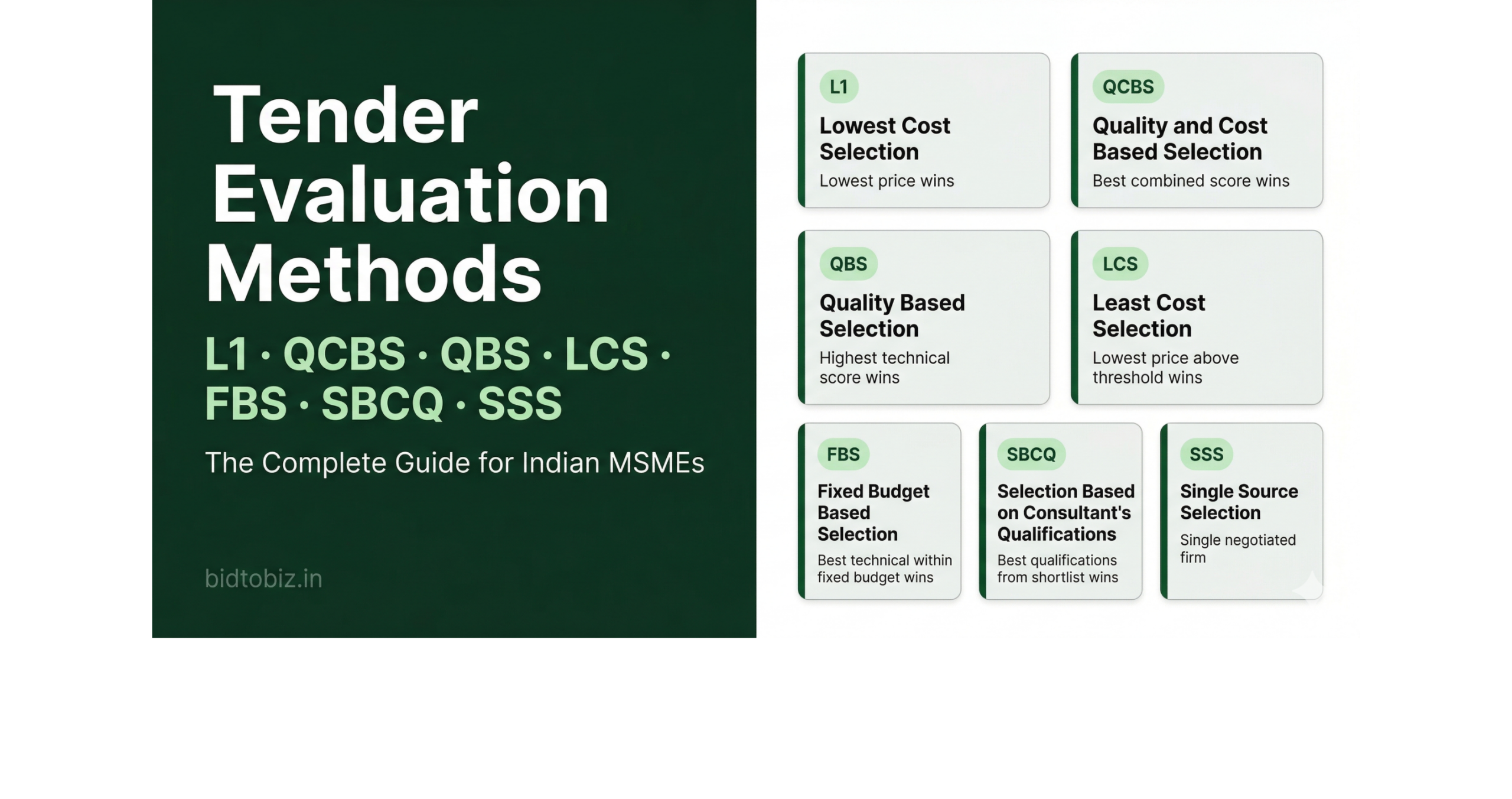
The Complete Guide to Tender Evaluation Methods in India: L1, QCBS, QBS, LCS, FBS and More
- Why tender evaluation methods matter more than you think
- L1 — Lowest Cost Selection
- QCBS — Quality and Cost Based Selection
- QBS — Quality Based Selection
- LCS — Least Cost Selection
- FBS — Fixed Budget Based Selection
- SBCQ / CQS — Selection Based on Consultant’s Qualifications
- SSS — Single Source Selection
- All methods at a glance
- What most MSMEs get wrong
- Pre-bid meetings: the underused weapon
Why tender evaluation methods matter more than you think
I learned this the hard way. Early in my tendering career, I’d spend days building a technically solid proposal, price it reasonably, submit it with full confidence — and then watch the award go to someone I knew was less capable. The tender evaluation method was the reason. I just hadn’t paid enough attention to it.
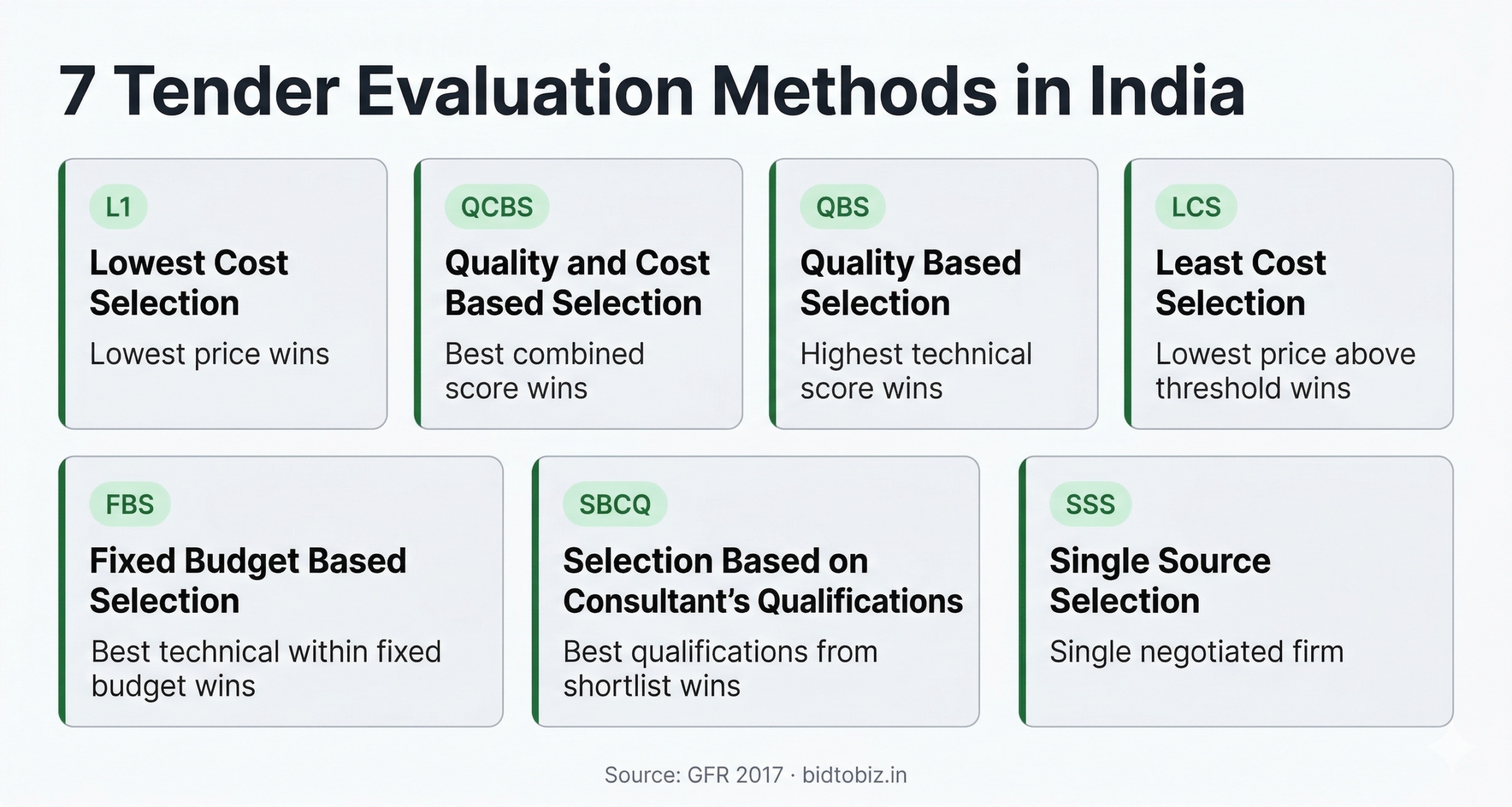
Every tender evaluation method reflects a philosophy. L1 says: the lowest price is the safest choice. QCBS says: we want quality, but we can’t ignore cost. QBS says: for this work, quality is everything — price is secondary. FBS says: we have a fixed budget; show us what you can do within it.
Once you understand the philosophy behind a tender evaluation method, you understand the buyer. And understanding the buyer is 70% of winning.
L1 — Lowest Cost Selection
Method 01The most common tender evaluation method in India
L1 means: among all technically qualified bids, the contract goes to the one with the lowest price. No technical weightage in the final score. No bonus points for better methodology or stronger team credentials. If your price is the lowest and your documents are in order, you win.
L1 has been the default procurement mode for Indian government agencies under the General Financial Rules (GFR) for decades. It is used across ministries, PSUs, and public agencies for standard works and routine non-consultancy services — civil maintenance, security services, office supplies, and any procurement where the output is well-defined and quality can be adequately specified upfront.
The problem: reality doesn’t always cooperate. The firm quoting the lowest price wins the contract, then discovers their price cannot support the quality the buyer expects. Cost overruns, delays, corner-cutting, disputes. The CVC, CAG, and NITI Aayog have all flagged this — which is exactly why the Department of Expenditure revised its procurement guidelines to allow QCBS for works and non-consultancy services.
⚠ Warning: Never quote absurdly low hoping to win and renegotiate later. Many RFPs now include provisions to reject bids below a certain percentage of the estimated project cost. Getting flagged as an “abnormally low bid” can disqualify you entirely before evaluation even begins.
Your bidding strategy for L1
- Pricing is the entire game — know your absolute cost floor before quoting
- Build market intelligence on what competitors are likely to quote
- Always check for an “abnormally low bid” rejection clause in the tender document
- Never quote below the minimum specified percentage of the estimated project cost
QCBS — Quality and Cost Based Selection
Method 02The tender evaluation method that rewards capability
QCBS is where things get interesting — and where prepared MSMEs have the biggest advantage over firms that only know how to compete on price.
Under this tender evaluation method, both your technical proposal and your financial proposal are scored and combined using a pre-determined weightage — typically 70% technical + 30% financial, or 80% technical + 20% financial. Whoever has the highest combined score wins. Not necessarily the lowest price.
How the two-envelope system works
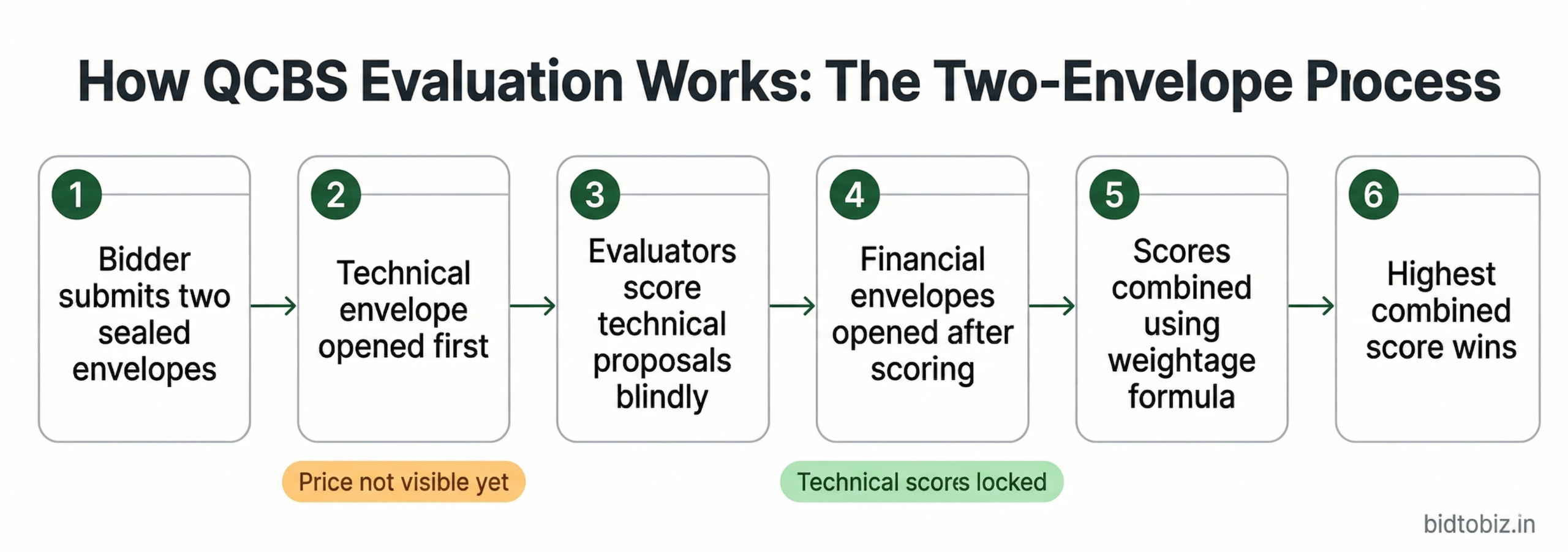
You submit technical and financial proposals in separate sealed envelopes simultaneously. Technical proposals are opened and evaluated first. Only after technical scores are finalized are the financial envelopes opened. This prevents price anchoring — evaluators score your technical bid without ever seeing your price.
QCBS scoring: a real example
Weightage: 70% technical, 30% financial.
| Bidder | Technical score | Price quoted | Tech (normalised) | Financial (normalised) | Combined 70:30 |
|---|---|---|---|---|---|
| A WINS | 85 | ₹50 L | 92.4 | 90.0 | 91.7 |
| B | 92 | ₹65 L | 100.0 | 69.2 | 90.8 |
| C | 78 | ₹45 L | 84.8 | 100.0 | 89.4 |
Bidder A wins — not the highest technical score, not the lowest price, but the best balance. Bidder C, who would have won under L1, finishes last here.
Note: As per revised DOE guidelines, the maximum technical weightage under QCBS for non-consultancy services and works cannot exceed 30%. For consultancy services, it can be as high as 80%.
Your bidding strategy for QCBS
- Your technical proposal is a revenue-generating document — treat it that way
- Map your credentials against each weighted sub-criterion specifically, not equally across all
- A strong technical score gives you direct pricing room — don’t race to the bottom
- Know the weightage split before deciding how much to invest in each proposal section
QBS — Quality Based Selection
Method 03The tender evaluation method where price doesn’t compete
QBS is the simplest conceptually and the rarest in practice. Only the technical proposal is scored. The financial proposal is not evaluated competitively at all. The highest-ranking technical bid wins, and the buyer then negotiates a price directly with that firm. Financial proposals from all other bidders are returned unopened.
QBS is used for highly complex, highly specialized assignments — cutting-edge technical research, complex legal advisory, high-stakes policy work, or innovative design where you genuinely cannot specify the output in adequate detail upfront. In Indian government procurement, it is explicitly available under GFR for consultancy services but used sparingly. You’ll encounter it more in multilateral-funded projects.
Your bidding strategy for QBS
- Everything rides on your technical proposal — CVs must be impeccable and current
- Your methodology must be specific to this assignment, not recycled from a past proposal
- If ranked first, negotiate financial terms knowing your cost floor and full line-item justification
LCS — Least Cost Selection
Method 04The tender evaluation method most bidders misread
LCS is the middle ground between L1 and QCBS that many bidders don’t realize exists as a distinct tender evaluation method. Under LCS, there is a scored technical evaluation with a minimum qualifying threshold — say, 75 out of 100. Any firm crossing this threshold is technically responsive. Among all qualifying firms, the contract goes to the one with the lowest financial proposal. The actual technical scores above the threshold are completely irrelevant to final selection.
The key difference from L1: L1 has a binary pass/fail technical qualification based on eligibility criteria. LCS has a properly scored technical evaluation with a threshold. LCS is prescribed for standard professional services where the ToR is well-defined — accounting and audit services, routine engineering inspections, standard training programs, simpler IT services.
⚠ Common mistake: Many bidders see LCS, focus only on pricing, submit a careless technical bid — and get knocked out in Stage 1 before financial envelopes are even touched. The threshold is a real gate. Treat it seriously.
Your bidding strategy for LCS
- Clear the technical threshold first — that is your only technical goal
- Obsessing over scoring 88 vs 78 technically is wasted energy — both reach the final round
- Once you’ve cleared the threshold, sharpen your pencil entirely on price
FBS — Fixed Budget Based Selection
Method 05The tender evaluation method that surprises first-timers
Under FBS, the buyer tells you the budget upfront — the cost of consulting services is specified as a fixed number in the tender document itself. You cannot propose a higher price; doing so gets you disqualified. Among all firms proposing within the fixed budget and submitting technically acceptable proposals, the one with the highest technical score wins.
Financial proposals here function purely as a pass/fail filter. The real competition is entirely technical. The revised DOE guidelines added FBS as a fourth option alongside QCBS, LCS, and QBS for consultancy procurement.
Your bidding strategy for FBS
- Stay within the budget — there is zero competitive advantage to quoting lower
- All energy goes into the technical proposal: methodology, team, work plan
- This is the one tender evaluation method where financial strategy requires almost no thought
SBCQ / CQS — Selection Based on Consultant’s Qualifications
Method 06Used for small, simple, short-duration assignments where a full competitive process isn’t justified. The buyer directly evaluates the credentials of three to five shortlisted firms and selects the most qualified one. No elaborate proposals, no detailed methodology documents, no scored financial comparison. Think of it as a streamlined version of QBS for low-value, low-complexity work. The key condition: this tender evaluation method is only appropriate when the budget is below a specified threshold and the task is simple enough that a full process would be disproportionate.
SSS — Single Source Selection
Method 07SSS means no competition at all. The buyer identifies one firm and negotiates directly. SSS is permitted only under specific circumstances: continuation of prior work where switching firms would cause significant cost and inefficiency; ultra-specialized capability existing in only one firm; a genuine emergency where competitive processes would cause unacceptable delay; or low-value assignments below specified thresholds. If you’re ever invited for SSS, the negotiation stage is your arena. Know your actual costs thoroughly before you sit across the table.
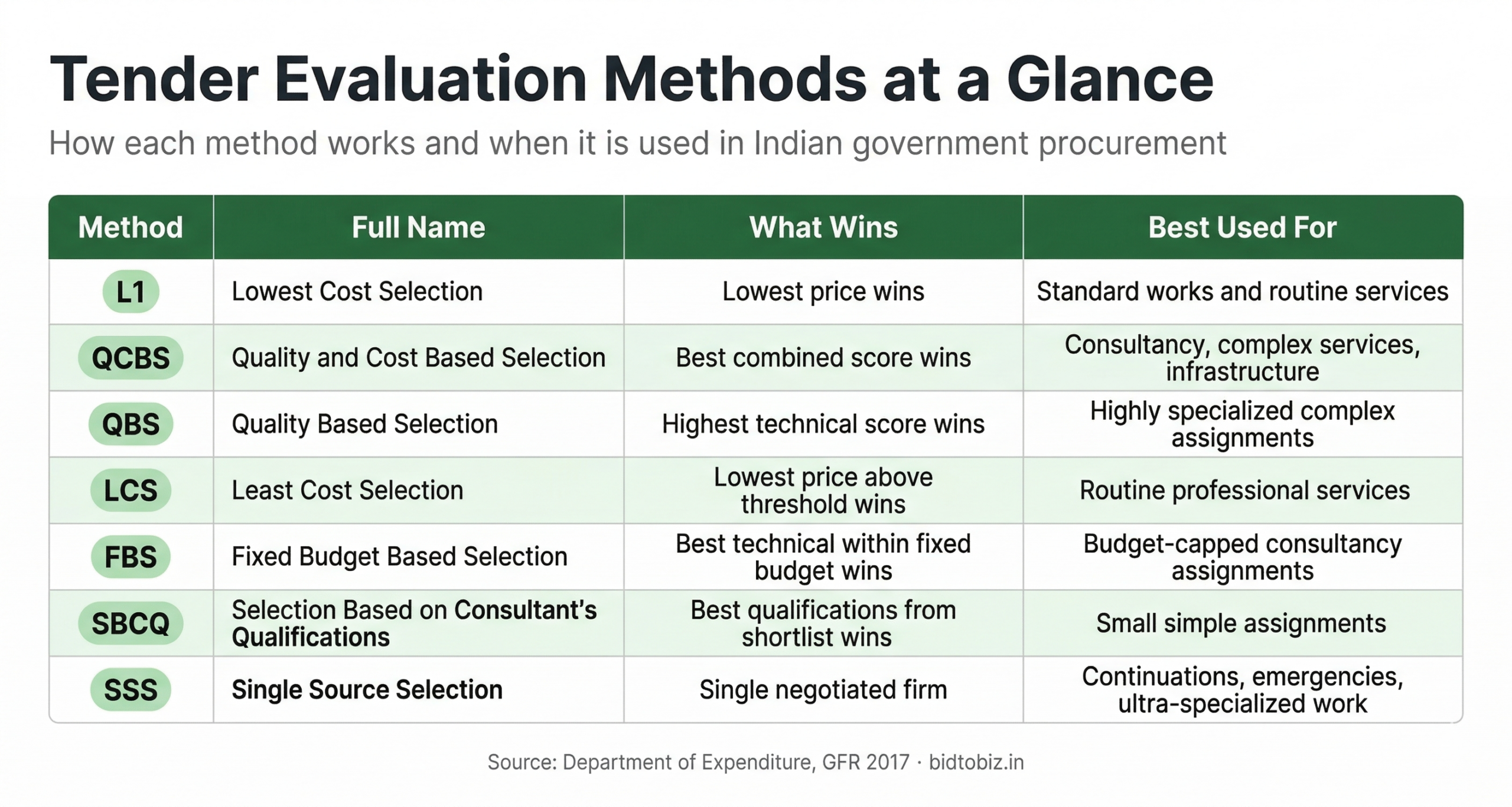
All tender evaluation methods at a glance
What most MSMEs get wrong about tender evaluation methods
Most small businesses in India walk into every tender with one strategy regardless of the tender evaluation method being used. Qualify technically, quote the lowest price they think they can survive on, hope for the best.
That works for L1. It loses in QCBS. It wastes money in FBS. It gets you eliminated before the financial round in LCS if you’ve rushed your technical proposal.
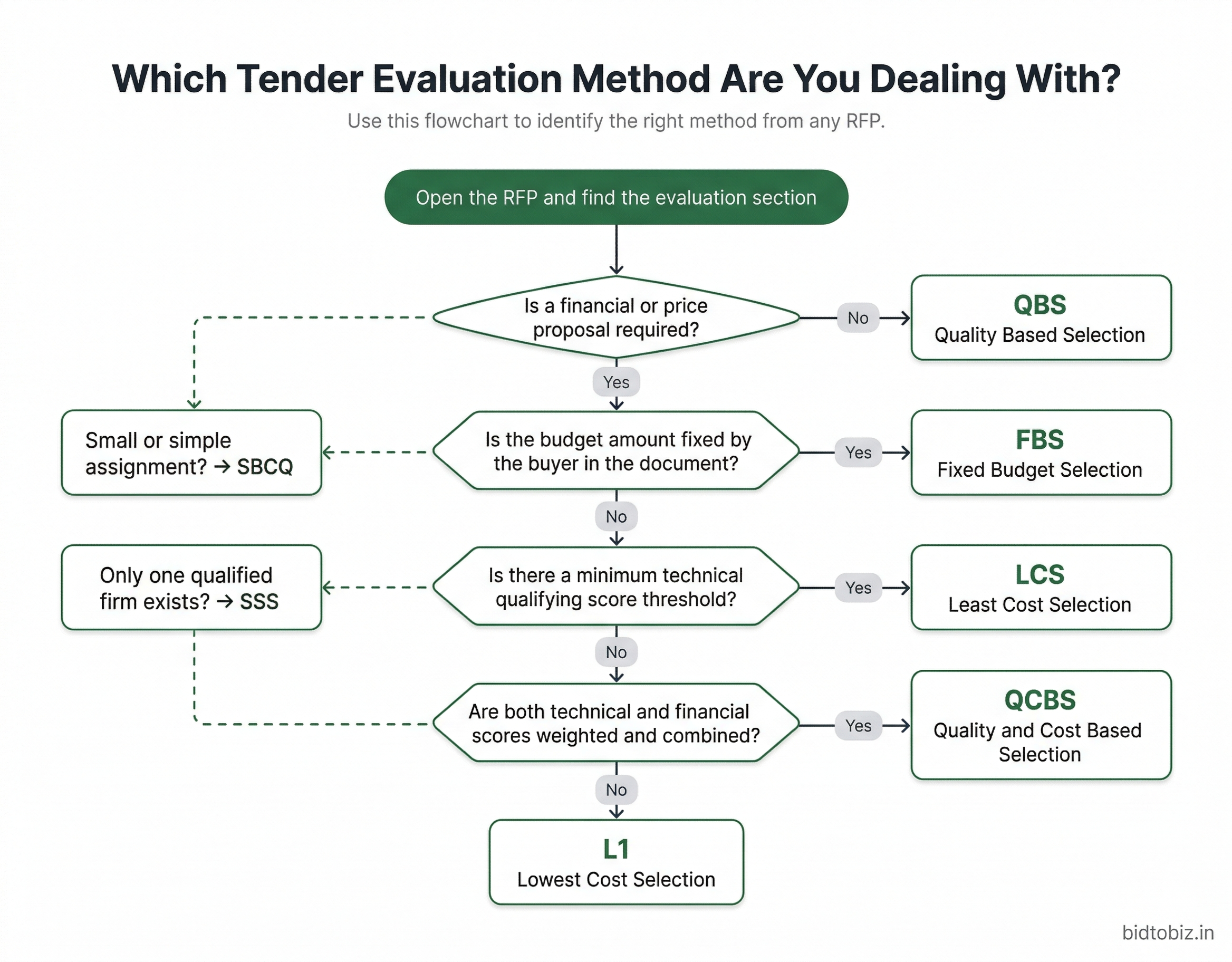
The first thing I do when I open any RFP is go directly to the evaluation methodology section. Before I read the scope of work. Before I check eligibility criteria. Before I look at timelines. Because everything I do after that depends entirely on the tender evaluation method being used.
My method-by-method approach
- L1 — build a detailed cost model first, then price
- QCBS — map technical strengths against each weighted sub-criterion before writing a word
- QBS — call your best people; update every CV before writing a word
- LCS — clear the threshold, then sharpen the pencil entirely on price
- FBS — budget is fixed; make the technical proposal outstanding
Pre-bid meetings: the most underused weapon in tender evaluation
Many bidders don’t realize that the pre-bid meeting exists precisely to challenge evaluation criteria that are ambiguous, unreasonable, or don’t reflect actual requirements. If the technical parameters in an RFP seem arbitrarily designed to favor certain types of firms — if experience requirements seem oddly specific, or if the weightages don’t make logical sense — you can raise this at the pre-bid stage.
Evaluation criteria change meaningfully after pre-bid queries. Not always. But often enough that attending and submitting queries is always worth the time.
Understanding tender evaluation methods properly is what separates firms that win tenders from firms that just submit them. Read the method first. Build everything else around it.
Have a tender you’re trying to decode — or need help building a winning proposal strategy?
